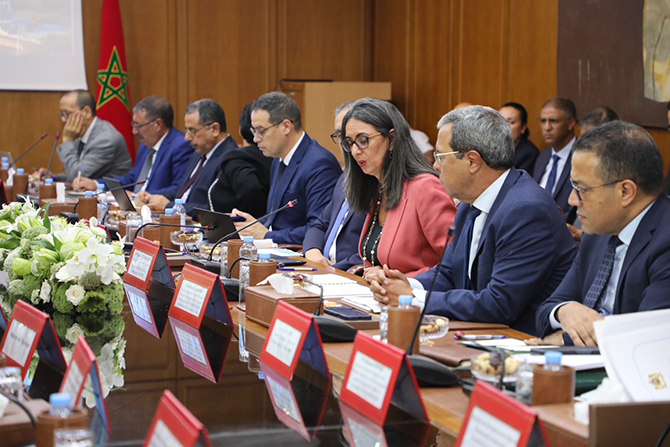
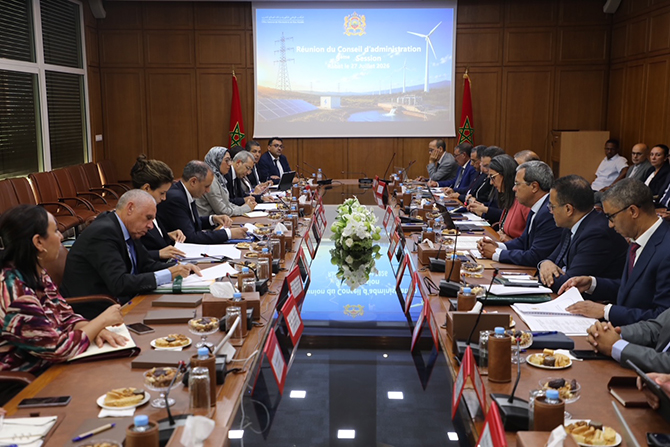
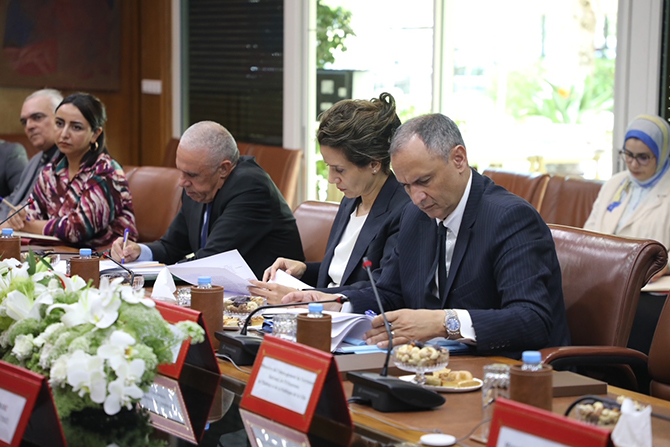
The 9th session of the Board of Directors of the National Office of Electricity and Drinking Water (ONEE) was held on Monday, 27 July, in Rabat, under the chairmanship of Mrs. Nadia FETTAH, Minister of Economy and Finance, acting on behalf of the Head of Government.
This session was attended by Mr. Ryad MEZZOUR, Minister of Industry and Trade; Mrs. Leila BENALI, Minister of Energy Transition and Sustainable Development; Mr. Abdellatif ZAGHNOUN, Director General of the National Agency for the Strategic Management of State Holdings (ANGSPE); Mr. Tarik HAMANE, Director General of ONEE; as well as senior officials and the other members of the Board of Directors representing the relevant ministerial departments.
The proceedings of this session were mainly devoted to the approval of the 2026–2030 Capital Investment Plan and the Office’s Action Plan and Budget for the 2026 financial year, the review of the 2025 performance report, and the approval of the 2024 and 2025 financial statements.
In her opening address, the Minister of Economy and Finance highlighted the importance of this Board session, which was being held against a backdrop marked by major challenges relating to the Kingdom’s energy transition and water sovereignty. She commended the laudable efforts of ONEE and its teams to implement the High Royal Guidelines in the fields of energy, water and sustainable development.
The Director General of ONEE highlighted the profound changes affecting the electricity and drinking water sectors. He also emphasised the Office’s mobilisation to address the challenges associated with preserving water resources, increasing demand, and fluctuating fuel and raw material prices.
Mr . Tarik HAMANE stated that the Office’s action plans would be geared more towards supporting initiatives to decarbonise the national economy and promote private investment. The Office has also launched several strategic projects aimed at overhauling and ensuring the sustainability of its model, modernising its management and enhancing the reliability of its management tools.
Mr. Tarik HAMANE presented ONEE’s 2025 performance report, highlighting the implementation of an investment programme worth more than 7.3 billion dirhams, including MAD 4.6 billion for electricity and MAD 2.7 billion for drinking water activities.
These investments increased installed electricity generation capacity to 12,314 MW, of which 46.1% was from renewable energy sources, thus moving closer to the Kingdom’s target of increasing their share to more than 52% by 2030. These achievements also made it possible to establish an overall drinking water flow capacity of 7.5 million m³/day, thereby raising the rate of access to drinking water in rural areas to 98.9%, benefiting approximately 13.65 million inhabitants. They also included the completion of the Sidi Ifni desalination plant, which was commissioned in February 2025 with a capacity of 3.15 million m³/year, bringing the number of desalination plants developed by the Office to 13, with a total capacity of 85.3 million m³/year.
In 2025, the Office met electricity demand, which reached 49 TWh, representing a significant increase of 7.4% compared with the previous year, with a peak demand of 7,990 MW. This level was exceeded in July 2026, when a record of 8,400 MW was reached, representing an increase of 410 MW in just one year. Regarding drinking water activities, the Office’s production in 2025 stood at 1,417 million m³, including 977.8 million m³ from surface water, 367.2 million m³ from groundwater resources and 72.5 million m³ from seawater desalination. Furthermore, construction work on the Casablanca desalination plant, with a total capacity of 300 million m³, has currently reached a completion rate of 81% for the first phase of 200 million m³, and its commissioning is scheduled for 1 February 2027.
The Director General of ONEE then presented the 2026–2030 Capital Investment Plan, focusing on the development and implementation of projects aimed at accelerating the energy transition through the large-scale integration of renewable energy, the development of appropriate storage and flexibility solutions, and the reinforcement and expansion of the transmission grid. This will make it possible to exceed, as early as 2028, the target of a 52% share of renewable energy in the electricity mix in terms of installed capacity. This Capital Investment Plan provides for a total allocation over the 2026–2030 period of MAD 177 billion for electricity and MAD 42.1 billion for drinking water, 72% of which will be financed directly by the private sector. This plan provides for the implementation of a MAD 104 billion programme to develop renewable electricity generation capacity, with an additional renewable energy capacity of 11.6 GW and an additional storage capacity of 2.6 GW, representing approximately 80% of the total additional capacity planned for the 2026–2030 period.
Indeed, the implementation of the renewable energy programme requires storage and flexibility solutions to be anticipated, particularly through the implementation of Battery Energy Storage System (BESS) projects with a total capacity of 2,230 MWh, the 360 MW El Menzel pumped-storage hydroelectric power plant, and a 3,744 MW natural gas flexibility programme. These projects will actively support the integration of renewable energy and ensure the stability of the electricity system and its operation under optimal conditions.
With regard to drinking water activities, the capital investment programme for the next five years focuses on securing drinking water production, strengthening supply to rural areas, and optimising the efficiency of existing production networks. Upon completion of this programme, desalination capacity intended for drinking water will reach more than 1.3 billion m³ per year and will contribute to meeting 63% of drinking water needs, compared with 13% in 2025 and less than 8% in 2023. The main desalination plants are those of Casablanca, the Oriental region, Tangier, Souss-Massa, and Guelmim/Tan-Tan.
At the conclusion of its discussions, the Board approved all the resolutions submitted to it, which are aligned with the Office’s objectives, both in terms of developing ONEE’s activities and improving its technical and managerial performance.
At the end of the meeting, Mrs. Nadia FETTAH reiterated her thanks to ONEE’s partners and teams. For his part, the Director General thanked the Chairwoman and the members of the Board of Directors for their continued support, while reiterating his commitment to pursuing the Office’s ambitious development programme.