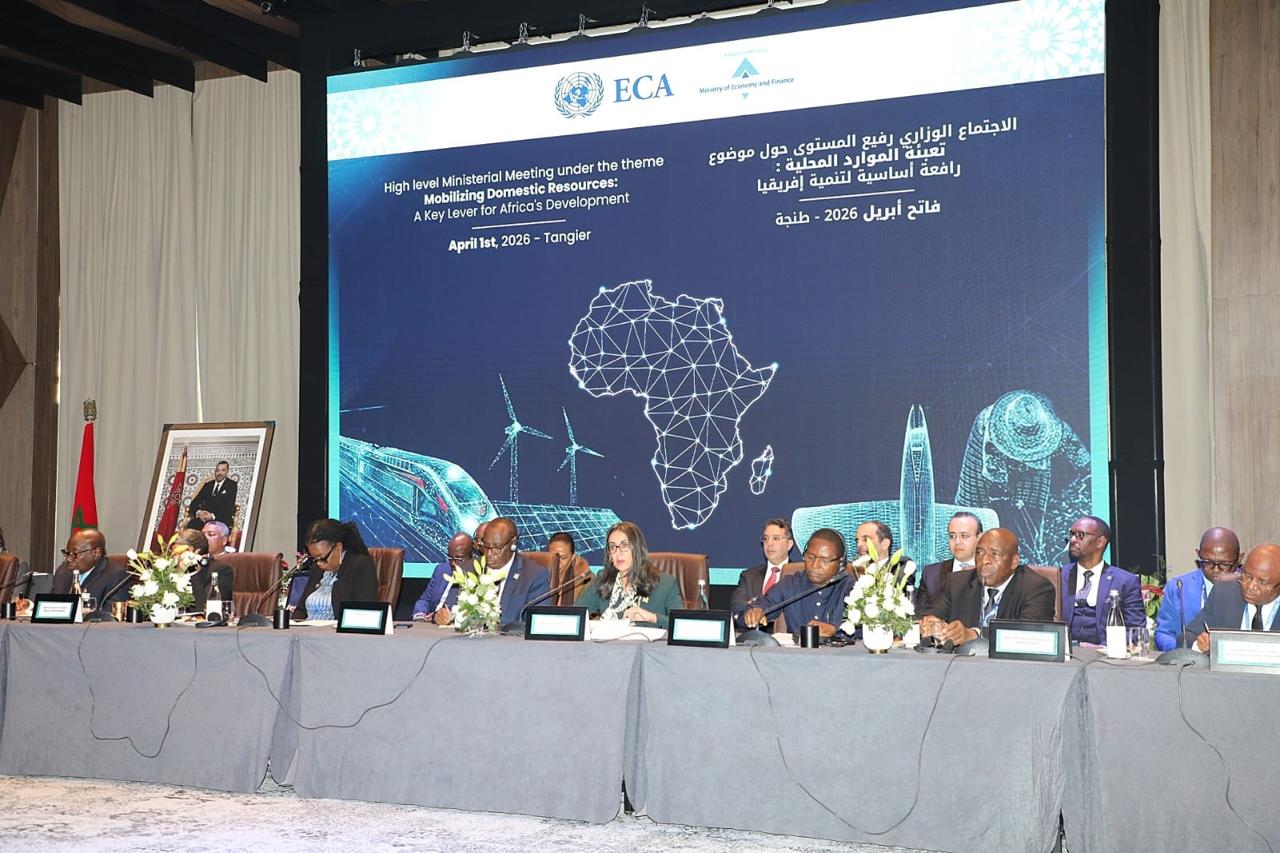
Madam Nadia FETTAH, Minister of Economy and Finance, chaired, on April 1, 2026, the High-Level Ministerial Meeting organized by the Ministry of Economy and Finance jointly with the ECA under the theme: “Domestic resource mobilization: a key lever for Africa’s development.”
At the end of this Meeting, a Ministerial Declaration was adopted, reflecting the collective commitment of stakeholders regarding domestic resource mobilization and calling for its translation into concrete actions for its implementation, particularly in collaboration with African and international financial institutions.
This Ministerial Meeting was organized on the sidelines of the Conference of African Ministers of Finance, Planning and Economic Development of the United Nations Economic Commission for Africa (COM58), which is taking place from March 28 to April 3, 2026, in Tangier.
The objective of this Meeting is to strengthen domestic resource mobilization in Africa through a high-level policy dialogue and the institutionalization of operational mechanisms for coordination, South-South cooperation, and experience sharing.
This event was attended by African Ministers of Finance, Planning, and Economic Development, as well as representatives of major African financial institutions.
In addition to the address by the Minister, the opening ceremony of this Ministerial Meeting was marked by speeches delivered by Mr. Claver Gatete, Executive Secretary of the ECA, and Mr. Kevin Chika Urama, Chief Economist and Vice President for Economic Governance and Knowledge Management at the African Development Bank Group.
In her opening address, the Minister emphasized the strategic importance of the theme of this Ministerial Meeting in light of the challenges that countries on the continent continue to face in an uncertain international context marked by successive crises.
In this regard, the Minister stressed that domestic resource mobilization constitutes an essential lever for development, enabling the financing of reforms and projects undertaken by African countries, while limiting reliance on monetary financing and preserving debt sustainability as well as macroeconomic stability in African countries.
During the discussions, participants welcomed the choice of the theme of this Ministerial Meeting, which lies at the heart of the current debate on the need to mobilize domestic resources to compensate for the volume of external financing allocated to African countries, enabling them to implement development programs and projects.
Similarly, this Ministerial Meeting provided an opportunity to share countries’ experiences in domestic resource mobilization, particularly through the digitalization of tax procedures, the use of innovative financing, and the promotion of private sector investment.
At the conclusion of this Meeting, a Ministerial Declaration was adopted, reflecting the collective commitment of stakeholders regarding domestic resource mobilization and calling for its translation into concrete actions for its implementation, particularly in collaboration with African and international financial institutions.
This Declaration focuses on the following main areas:
(1) The context and challenges of domestic resource mobilization, which notably include the decline in official development assistance, the need to establish mechanisms in support of domestic resource mobilization, and the fragility of public finances, particularly characterized by the reduction of fiscal space.
(2) The objectives and commitments for strengthening the capacities of African countries, aimed at accelerating tax reforms, promoting the dissemination of innovations in tax digitalization, budget management and savings mobilization, and strengthening budgetary governance.
(3) Cooperation with international partners, through supporting African countries in implementing the commitments set out under this Declaration.
(4) Regional governance and monitoring of the commitments set out under this Declaration, through the establishment of an inter-African working group to oversee its implementation.