As a country part of both the Greater Maghreb and the Arab world, located in North-West Africa, the Moroccan territory is bounded to the north by the Strait of Gibraltar and the Mediterranean Sea, to the south by Mauritania, to the east by Algeria and to the west by the Atlantic Ocean. Its geographical location, at the crossroads of three worlds between which it has always served as a link between Africa, the Mediterranean and Europe makes this land a true melting pot of civilizations.
Morocco covers a total area of 710,850 sq. m while its coastline stretches over 3,500 km.
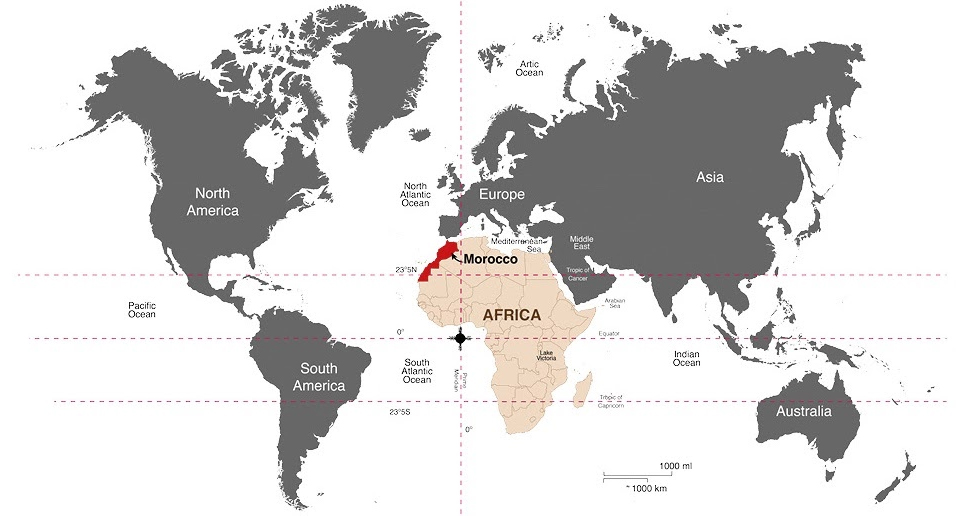
Morocco is a nation steeped in history. Recent archeological discoveries trace its roots back to time immemorial. Its several thousand-year-old civilization is the result of the passage of many conquerors: Phoenicians, Carthaginians, Mauritanians, Romans, Vandals, Byzantines, Visigoths. The Arab conquest introduced Islam and marked the history of Morocco.
Prehistory
The oldest fossil of Homo sapiens was found in Morocco in 2017. The discovery shook the history of the origin of humanity, suggesting that our species actually goes back 300,000 years and has evolved in several hotspots on the African continent.
Archaeologists are able to date the arrival of the first ancestors of the current Berber populations at 9,000 years BC. Neolithic sites near Skhirat and Tetouan show early traces of sedentary lifestyle and the birth of agriculture.
From the Phoenicians to the Greeks of Byzantium.
The Phoenicians were the first to explore Morocco, as early as the 11th century BC, by establishing trading posts. The cities of Tangier, Lixus, Sala, Mogador (Essaouira) were Phoenician trading outposts. The Phoenician influence was followed by the Carthaginian influence, which took advantage of the coastal areas to venture and establish themselves deeper inland. The Carthaginians founded outposts in Tangier and Essaouira, while building a city on the site of present-day Rabat.
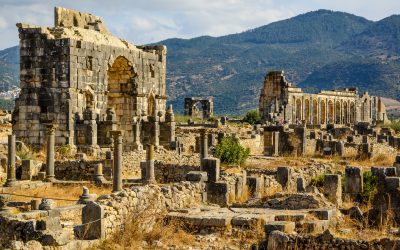
In 40 AD, the northern region of Morocco was annexed to the Roman Empire. Volubilis is the most important ancient Roman site in Morocco, listed as a UNESCO World Heritage Site since 1997. The presence of Rome on Moroccan soil lasted until the 3rd century. At the beginning of the 5th century, the country shifted to become under the domination of the Vandals, of Germanic origin, until the middle of the 6th century, a period which saw the Byzantine Emperor Justinian I annihilate the Vandal kingdom.
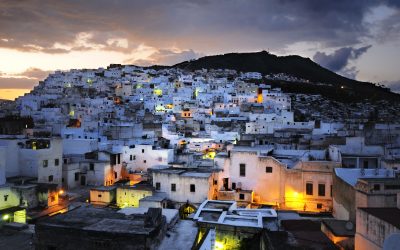
Arab Conquests and Successive Dynasties
The end of the 7th and the beginning of the 8th century are marked by the consolidation of the Arab conquests, under the reign of the Umayyads, and the Byzantine withdrawal. The Arabs brought their language – Arabic – and most importantly their religion – Islam – which was to impose itself throughout North Africa.
– The Idrissides (789 – 10th century)C'est la première dynastie royale à régner sur le Maroc. A l'origine, un prince arabe issu d'Ali, gendre du prophète, réfugié dans le Moyen Atlas, que les Berbères locaux portent à leur tête en 789 sous le nom d'Idriss 1er. Son fils posthume, Idriss II, fonde alors la première dynastie royale du Maroc, avec Fès pour capitale. On doit aux Idrissides la mosquée Al Quaraouiyine et celle des Andalous à Fès, les mausolées d'Idriss 1er à Zerhoun et d'Idriss II à Fès, ainsi que la mosquée du vieux Ténès en Algérie.
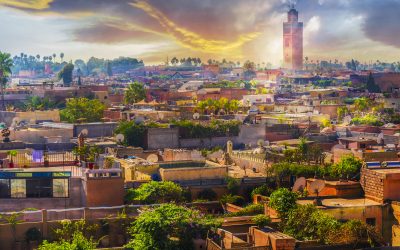
– The Almoravids (1069–1147)A Berber dynasty, formed from a nomadic clan from the Sahara, the Almoravids settled in 1058 and dominated an empire extending from the eastern confines of the Maghreb to Andalusia for a century. They carried out a remarkable unification process these different territories, based mostly on Islam and the notion of holy war. They also promoted a refined civilization, influenced by the Andalusian culture, to which they were close. They founded Marrakesh, the second imperial city of Morocco, after Fez. Marrakesh then lent its name to the country. Many buildings date from this period, the Great Mosque of Tlemcen, the mausoleum of the Abbadid King of Seville, Al Mutamid ibn Abbad in Aghmat (30 km from Marrakesh, at the foot of the High Atlas) or the Almoravid Qubba in Marrakech.
– The Almohads (1147–1248)The Almohad movement was founded in the High Atlas by a scholar by the name of Ibn Toumert who preached the return to the sources of Islam and opposed the Malikite rite practiced by the Almoravids. They overthrew the Almoravids and ruled over the Moroccan empire, including North Africa and Muslim Spain for a century; they made Rabat their imperial city. They have left an important trace in the history of this region by the brilliant culture they have been able to develop. The Almohads have left architectural treasures, both in Morocco (the Tinmel Mosque 100km from Marrakech, classified by UNESCO as a World Heritage Site, the Hassan Tower in Rabat, the Koutoubia in Marrakech) and in Spain (the Golden Tower in Seville, now the Navy Museum, the Giralda in Seville).
- The Marinid dynasty (1248–1548)The Merinids bequeathed a large number of historical monuments to Morocco, most of them in their capital, Fez, but also in other cities, the Chellah necropolis in Rabat and the Massourha mosque in Tlemcen, Algeria. The Merinid era was the era of the medersas, which were built in large numbers, making Morocco the Muslim country with the most medersas. We can mention the medersa Seffarine in Fez (called the school of boilermakers), Bou Inania of Meknes and Attalaâ of Salé.
- The Saadians (1548–1660)At the beginning of the 16th century, the Saâdians, Berbers from the Draâ valley, tired by the Christian offensives, revolted against the Marinids and drove them out of power. They founded their own dynasty and fought against the Portuguese. That’s how they took back Agadir. The final battle against the Portuguese took place on 4 August 1578, near Ksar el-Kébir (or Alcazar Quivir). This battle, called the “Battle of the Three Kings,” led to the annexation of Portugal by Spain two years later. The Saadians left us with a magnificent legacy in Marrakesh, the Saadian Tombs, a royal necropolis of great architectural richness.
– The Alaouite (1660 to the present day)The Alaouite take their name from their kinship with Ali, the Prophet’s son-in-law. Coming from Hejaz, they settled in Tafilalet. The Alaouites became sultans of Morocco following a period of instability following the death of the last sultan of the Saadian dynasty in 1659. It was Moulay Rachid, the third Alaouite prince of Tafilalet, who reunified the country between 1664 and 1669 and re-established a central power, thus marking the beginning of the Alaouite dynasty of Morocco. His son, Moulay Ismaïl, moved his capital to Meknes, 60 kilometers from Fez. He repelled various European offensives while fighting against rebellious Berber tribes in the mountains.
Meknes is by far the first great work of the dynasty, a city in the Hispano-Moorish style surrounded by high walls pierced by monumental gates; it reflects particularly well the harmony of Islamic and European styles.
Modern Morocco (1956 to the present)
From the day of the independence, the sultan took the title of king, under the name of Mohamed V. On 26 February 1961, his son Hassan II succeeded him until his death on 23 July 1999. His son, Mohammed VI became the twenty-third monarch of the Alaouite dynasty and the third to bear the title of King of Morocco.
Morocco’s landscapes
The unique geographical situation of Morocco is what makes its landscapes so diverse.
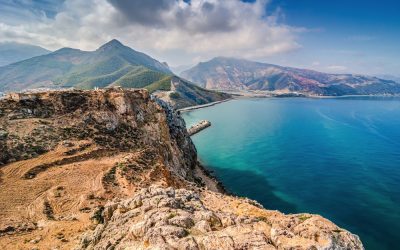
SEA AND OCEAN
The country is bordered to the west by the Atlantic Ocean and to the north by the Mediterranean Sea. Morocco has the longest coastline on the African continent with 3,500 km.
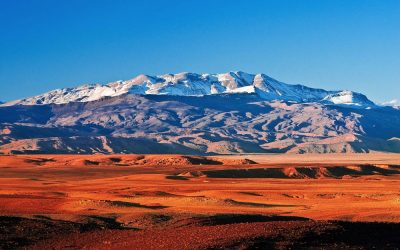
MOUNTAINS
They take up over two thirds of the territory and consist of four mountain ranges: the High Atlas, the Middle Atlas, the Anti-Atlas and the Rif. The Toubkal which culminates at 4,167 m is the highest summit in Africa.
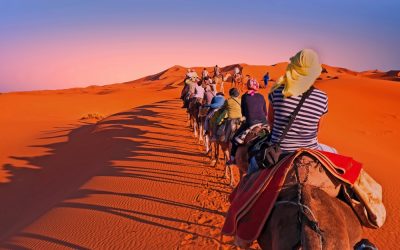
DESERTS
The many and varied Moroccan deserts mainly extend to the south. Whether stone deserts (regs), high plateaus (hamadas), or sand dunes (ergs), each one features their particularities but all of them fascinate the travelers coming here to find the serenity that is typical of the local inhabitants.
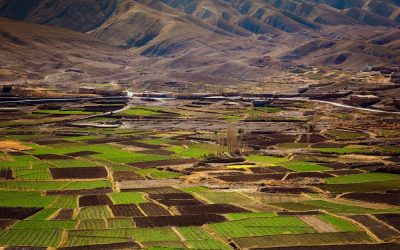
PLAINS
They stretch from the Rif Mountains to the Middle Atlas Mountains. The Sebou Basin, the plains of the Gharb, Souss and Haouz, bathed by numerous rivers are very fertile (citrus fruits and market gardening abound in particular); for the southernmost plains, the dam policy makes it possible to compensate for the rainfall deficit. Other smaller fertile plains and valleys are located mainly in the north: Lukos, Nekkor, Trifa, valley of the Ouergha, Baht, Inaouen wadis.
RIVERS
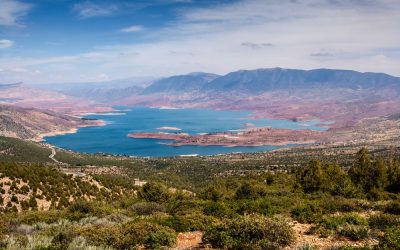
Among the great rivers of Morocco, the Moulouya has its source in the Middle Atlas and flows into the Mediterranean after a course of 520 km; the Sebou has its source in the Middle Atlas at an altitude of 2030 m; the Bouregreg, separates the cities of Rabat and Salé; the Tensift crosses Marrakesh and the Sous, Agadir; the Draa, which is 1100 km long, is visible only 50 km before its mouth and flows into the Atlantic Ocean.
THE FLORA
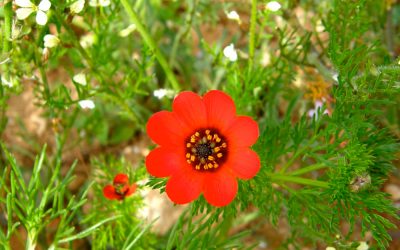
There are approximately 7,000 different species of known flora. The vascular flora is massively represented in forest ecosystems where almost two thirds of the species live; the remaining third is mainly shared between steppe formations and wetland biotopes.
 TREES OF MOROCCO
Morocco is characterized by many tree species.
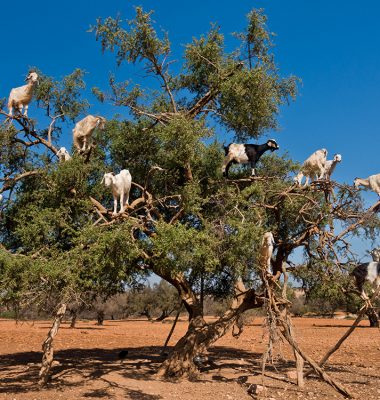
The argan tree is endemic in Morocco; its name comes from the Berber “argan” which designates either the species or the oil extracted from it. It is mainly found in the Souss and on the edge of the Sahara, in the Draâ region. Today, Argan oil is widely used for culinary and cosmetic purposes.
Tuya is also an almost endemic tree of the Atlas, more precisely of the Souss Massa region. It grows in semi-arid areas, both on plains and in medium-sized mountainous terrain; its dark red speckled wood with a characteristic smell is highly prized by craftsmen and cabinetmakers who make boxes, trays or furniture from it.
The olive tree, the Mediterranean chief symbol tree can be found throughout Morocco, but more particularly in the Anti-Atlas; its uses and benefits are multiple; olives and their oil are the basis of Moroccan cuisine. Its wood also has exceptional calorific properties.
The date palm is a plant with a hollow trunk that needs water, warmth and sun to grow. It has been cultivated for 4,000 years before our era. There are 4.5 million date palms in Morocco, two thirds of which are concentrated in the regions of Ouarzazate and Errachidia.
The cedar tree is also prevalent in Morocco, almost as much as it is in Lebanon. While Morocco has the main cedar grove in the Mediterranean basin (134,000 hectares) mainly in the Middle and High Atlas, this national treasure is threatened by climate change and human-induced environmental stress. A comprehensive preservation plan is being implemented to protect it.
On the border between Africa and Europe, Morocco has been cradled throughout its two thousand years of history by diverse influences. The Berbers, the original inhabitants of Morocco, have mixed throughout history with Jews and nomadic tribes from the south of the Kingdom. The latter have carried a unique language, Hassani. The Arabs conquered the country between the 7th and 11th centuries, when it was populated mainly by Berbers and Romano-Berbers. Today, Arab-Berbers represent 98% of the population; they are Sunni Muslims. Sub-Saharan come from what was once the empire of Ghana, which covered Senegal, Mauritania, Burkina Faso, Gambia and 85% of Mali. Descendants of Europeans joined Morocco after the Arabs withdrew from Europe in the 15th century.
The Moroccan People
Morocco has 35 million inhabitants, 62% of whom live in cities; although it is a young country, 42% of the population is under 25 years of age, as in other emerging countries, the underlying trend is an ageing population -; this is the result of the combination of a falling birth rate, linked to the rising level of education of women, and the increase in life expectancy, linked to the general health environment. From a demographic standpoint, with an average of 2.2 children per woman, Morocco remains one of the most dynamic countries in terms of birth rate.
The Moroccan diaspora (4.5 million Moroccans live outside Morocco) is increasingly contributing to the country’s economic development, under the effect of the socio-economic rise across all generations. Morocco is home to more than 80,000 foreigners mainly of European (40%) and African (42%) origin. (source: HCP 2014)
On the border between Africa and Europe, Morocco has been influenced throughout its 2,500 years of history by various cultures. The Berbers are the original inhabitants of Morocco, who were mixed with Jews and nomadic tribes in the south of the Kingdom during the course of history. The Arabs conquered the country between the 7th and 11th centuries. Today the Arab-Berbers represent 98% of the population, they are Sunni Muslims, of Malekite rite.
Musique, poterie, tapis, cuir, bijoux, broderie, cuisine… L'art marocain est la résultante des brassages civilisationnels dont est faite l'histoire du Royaume. En préservant son authenticité, il a su se renouveler et s'adapter à travers le temps.
Moroccan craftsmanship
Craftsmanship in Morocco is the fruit of a double heritage; firstly, that of the Berbers, the first inhabitants of Morocco who learned to work with wool, iron, silver and clay; and later that of the Arabs who introduced leather and wood work. Rich in thousand-year-old traditions, it is divided into five main sectors: clay, wood, metals, textiles and leather. As a living art, Moroccan craftsmanship is always innovating and reinventing itself, giving birth to new creations that big brands or major Western companies love to emulate. In 2018, crafts contributed 7% to the GDP.
Weaving
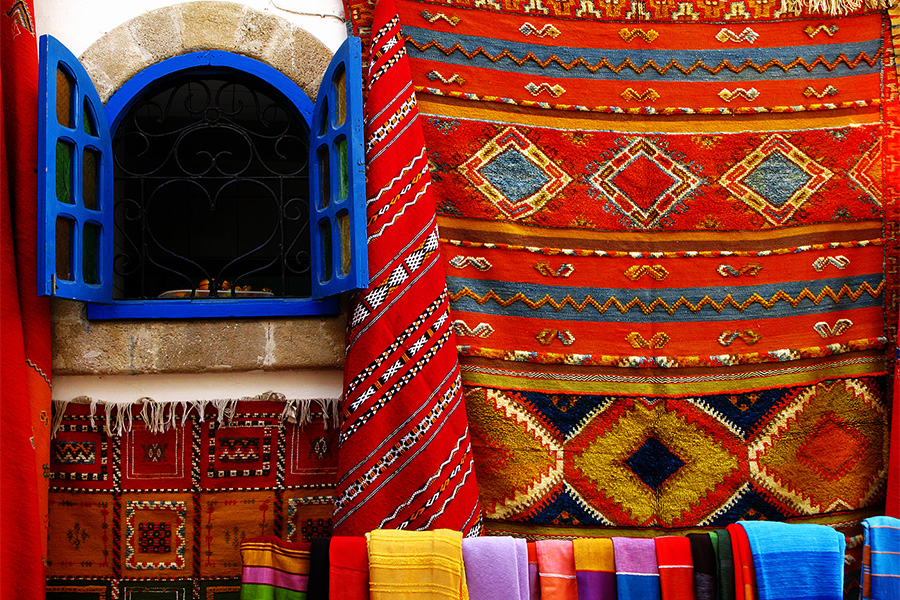
In Morocco women weave and men sell carpets in the traditional markets. Each region has its own style. The most prized are the carpets of the Middle Atlas, those coming from the Zemmour region (typically carpets featuring a red background with softer shades of orange or yellow), from Taza (generally white or ecru background) or from Meknes (colored background). Contrary to Berber carpets, the Rabat carpets are more of oriental inspiration, with dominant reds.
Wood
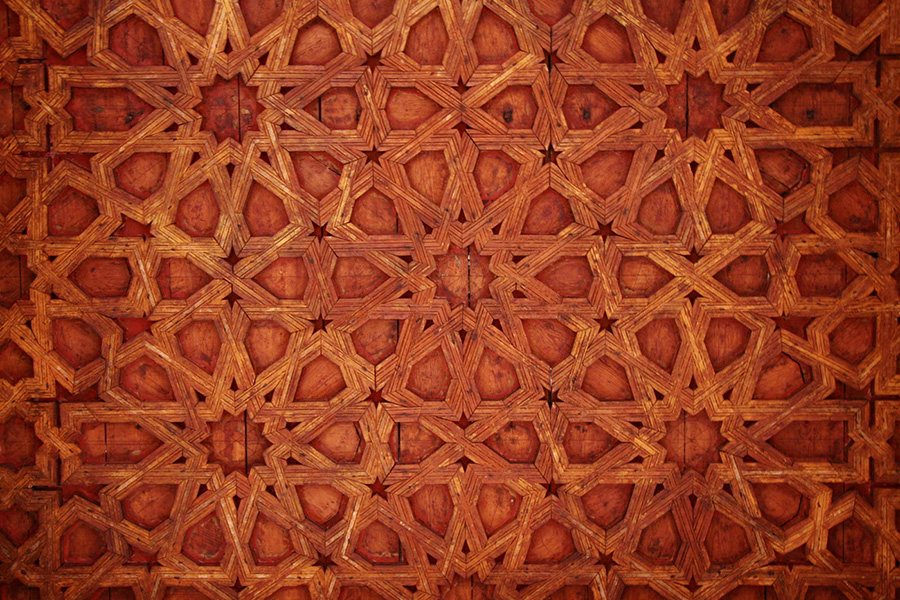
Wood is an ornamental material particularly prized in traditional houses, riads and palaces. Large carved wooden doors open onto the patios and the ceilings are always decorated with wood carvings. Many tree species are used in the craft: cedar, thuja, lemon tree… Vases, pedestals, trays and moucharaby are also made, often in cedar, with complex inlays.
Traditional Clothing
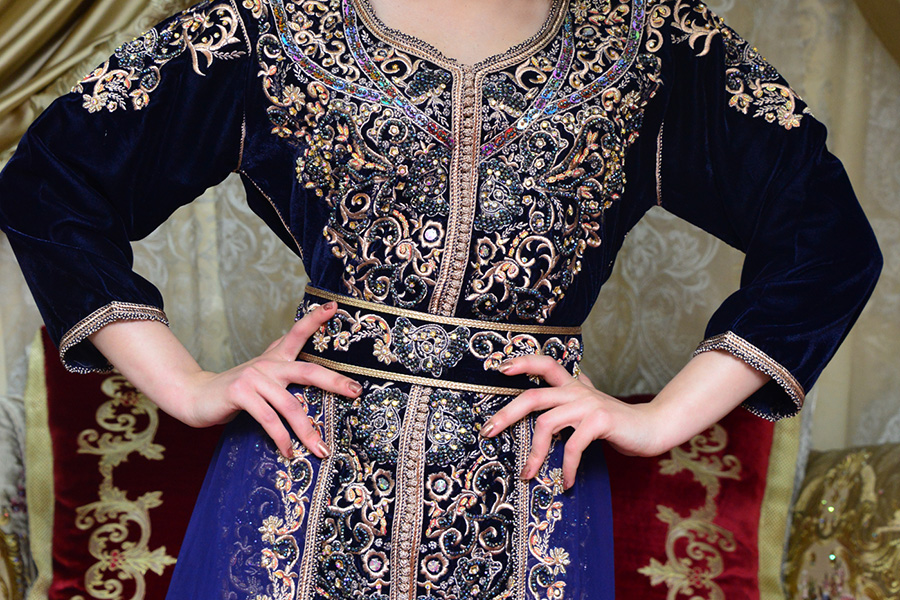
The caftans and djellabas make part of the basic traditional Moroccan wardrobe; it is still worn in all walks of life, especially during traditional ceremonies, weddings or evenings during the month of Ramadan. The caftan, available only to women, dates back to the Ottoman Empire. It is a long ceremonial dress, cut in noble materials (velvet, silk, brocade) and set with precious metal threads (gold or silver). An outdoor garment, the djellaba is worn by both women and men. Caftans and djellabas are continuously renewed to follow fashion trends, under the impetus of Moroccan designers.
Pottery and Ceramics
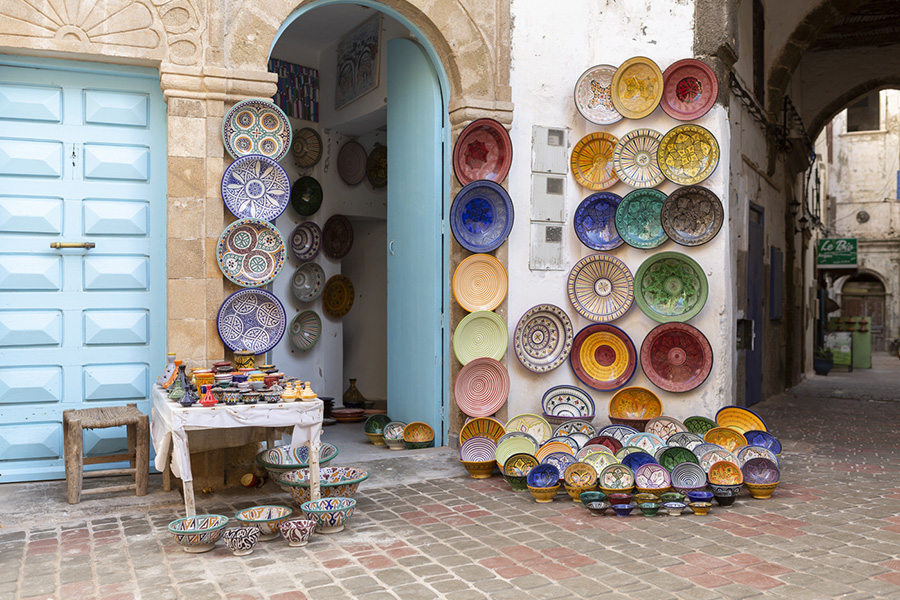
Three great schools compete in the pottery arts: Safi’s, Fez’s and the Berber School. The Berber pottery is soberly decorated, those of Fez and Safi, enameled with zellige (tiles) are decorated with more motifs and colors and characterized with Islamic art.
Jewelry
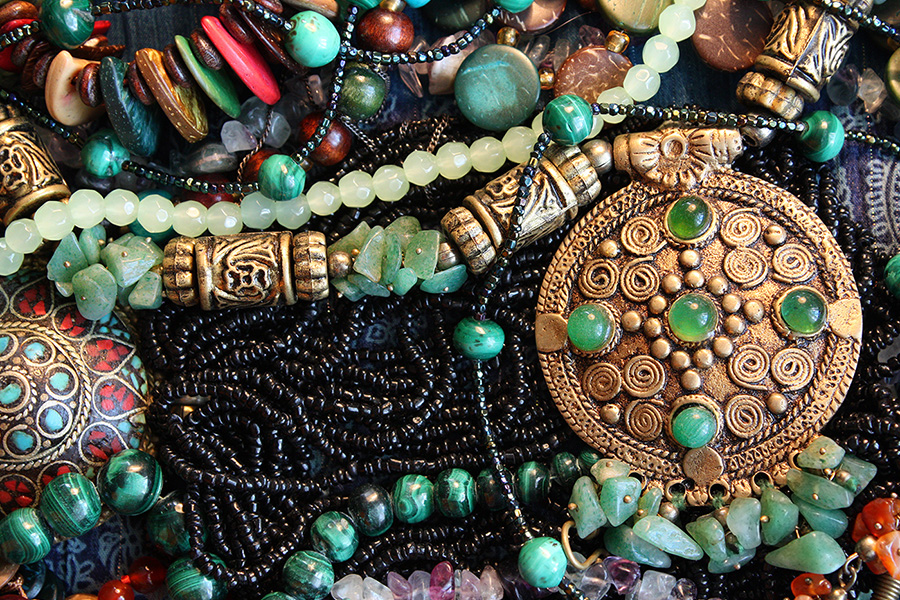
Of pure Berber tradition, the manufacture techniques employed to create Moroccan jewels are: filigree (silver wire), nielle (inlay), chiseling and engraving. Fibulas and bracelets are most often made of silver and inlaid with black or colored enamel.
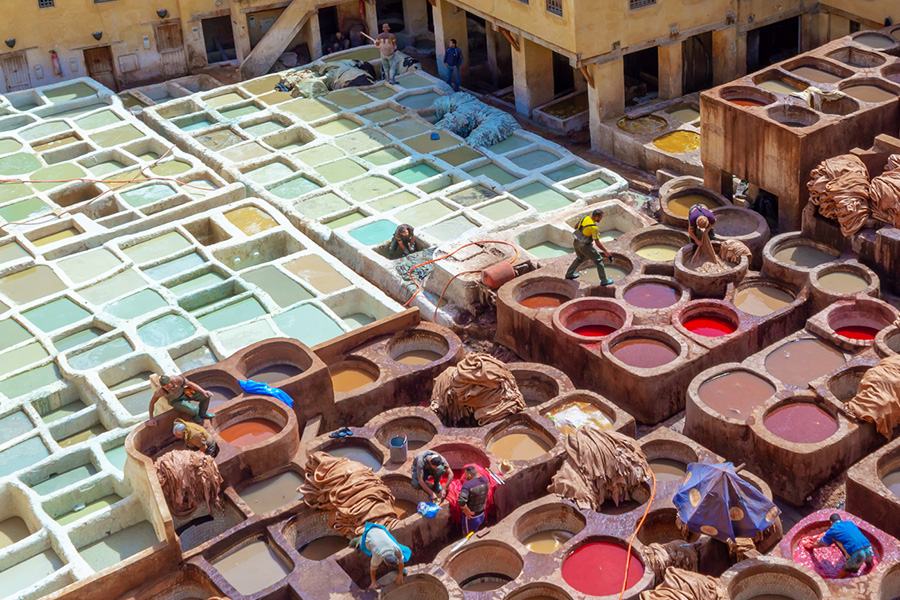
Leather
Leather working is a strong part of Morocco’s history, from which the French word maroquinerie or “leather goods” stems from; three trades take turns working leather: tanners, dyers and then leather workers; pouffes, bags, wallets and other accessories like slippers have made the reputation of the cities of Fez and Marrakesh for centuries.
Culinary excellence
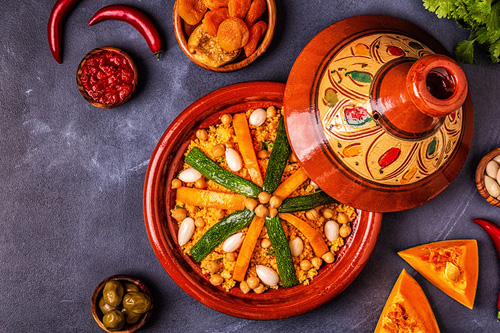
Wholeheartedly Mediterranean, with Berber, Arab and Jewish influences
Moroccan cuisine is considered one of the richest in the world, known for its profusion of flavors and colors. It is an important cultural marker. Couscous is a staple and legendary dish that no one can ignore. This dish has crossed borders and can be enjoyed in the greatest international restaurants. The recipe for couscous varies according to regions and family customs.
Tajine is one of the main dishes of Moroccan gastronomy. It takes its name from the typical glazed earthenware utensil in which it is cooked slowly on charcoal. This dish is most often composed of meat, vegetables, fruit and spices.
Festivals & events
Culture, holidays and festivals, everywhere and all year round
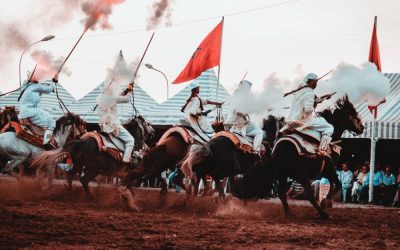
Moussems
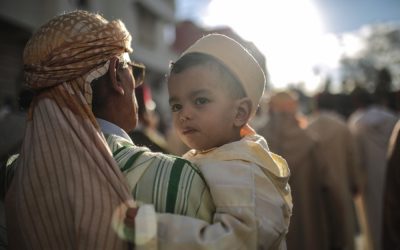
The Moussems are large annual gatherings made up of processions, popular songs, dances and fantasias (traditional exhibition of horsemanship). These events, a pretext for meditation and prayers, unite Moroccans around rites, beliefs and traditions. The Moussem of Tan-Tan was proclaimed a Masterpiece of the Oral and Intangible Heritage of Humanity by UNESCO in 2005.
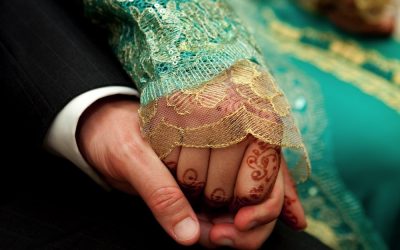
Weddings
In Morocco, the wedding ceremony gives rise to great celebrations, which can last from three days to a week; it remains closely linked to the country’s ancestral traditions and customs. The rites vary from region to region. Dress, songs and food differ according to the customs and culture of the region.
Other major gatherings
Other occasions bring community members together around regular events (almond festival, cherry festival, candle procession, etc.)
You can read more about it by visiting: www.patrimoineculturel.ma
Music in Morocco
Music in Celebration
Music holds a very special place in Moroccan society; very diverse, it illustrates the diversity of Moroccan cultures. It is composed of several musical genres, Andalusian and Judeo-Moroccan music, chaabi (a variety of popular music), gnoua and hassani music …
More recently, Moroccan music has also drawn its inspiration from contemporary Arab music from the rest of the Arab world (Egypt, Lebanon, Syria etc.)
Malhun
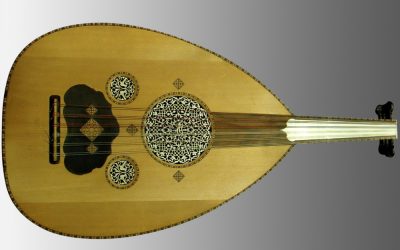
Malhun was born in the craft guilds of southern Morocco. Influenced by Andalusian musical styles, Malhun is a genre of sung poetry whose lyrics often relate to social and cultural issues. The art of Malhun consists of three parts: composition, conservation and interpretation. Each of these activities is carried out by a different master.
Gnaoua
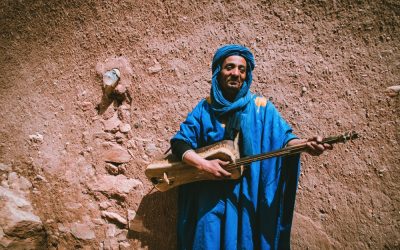
Gnawa is a Sufi brotherhood music generally associated with religious lyrics, which invokes ancestors and spirits. This popular music reaffirms Morocco’s African roots through a culture with sub-Saharan roots. Gnawa art has gained international renown through the fusion of this spiritual music with other foreign musical genres such as blues, jazz and reggae.

Ahwach
Ahwach is a music and a form of collective dance practiced in the Berber villages of the High Atlas and Anti-Atlas. This traditional music is presented in the form of animations where colorful shows alternate with exchanges between musicians.